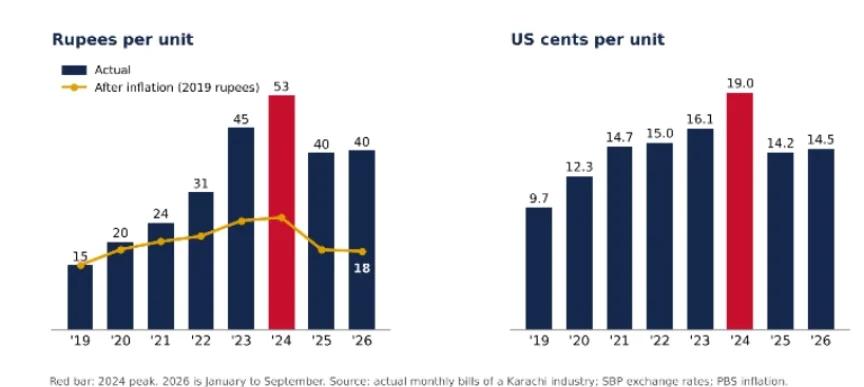
From Rehan Javed
In 2019, a Karachi factory paid about 7.8 US cents for every unit of electricity it used. By 2024 the same factory, on the same meter, was paying 15.1. Nothing about its machines had changed. Nothing about its product had changed. Its power bill had nearly doubled, and five years later nobody has given industry a straight explanation.
Credit first, because it is earned. The cross-subsidy charge on industry is gone, tariffs were cut from February, and the Power Division says industrial power now costs Rs 18.94 a unit less than at its March 2024 peak. The task force on IPP renegotiation tackled the hardest problem in the sector and reports savings of Rs 3,600 billion over the remaining life of the contracts. We thank them.
But thanks do not fix a bill. Today that factory pays about 11.5 cents, and that is still 47 percent above 2019. In a business where margins are thin and competitors are in Dhaka, Delhi and Ho Chi Minh City, 47 percent is the difference between running a shift and closing one.
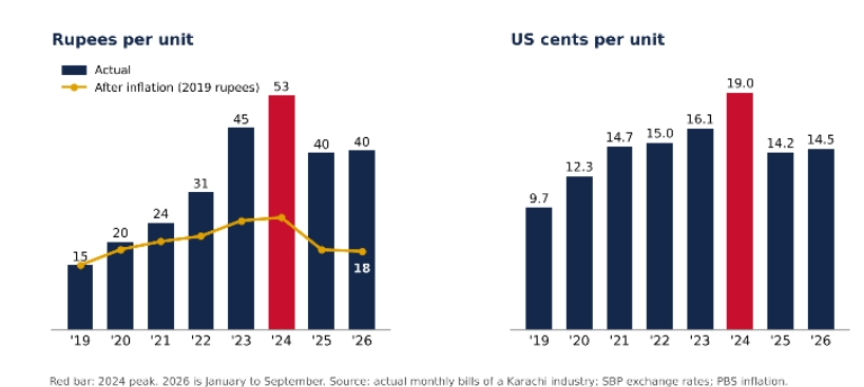
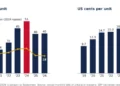
Actual monthly bills of one Karachi industrial account, including taxes (2026 is January to September). Source: the account’s bills; SBP exchange rates; PBS inflation. Without taxes, the same account paid about 7.8 cents in 2019, 15.1 in 2024 and 11.5 in 2026, and the pattern is the same.
This was not simply someone’s fault, and it is still unacceptable
We will not pretend the whole rise was avoidable. The rupee fell from about Rs 150 to about Rs 280 to the dollar. The 2022 fuel shock hit every country that imports LNG. Even after inflation, today’s bill is about 22 percent above 2019.
But our competitors faced the same shocks and came out cheaper. PIDE puts Pakistan’s industrial price at 15.5 cents over 2023 to 2025, against 12.4 in India, 10.0 in Bangladesh and 7.8 in Vietnam. What separates us, in our reading, is how much of our bill is fixed. About 93 percent of fixed costs are recovered through the per-unit charge, so when consumers fled to solar and grid sales fell from 125 to 111 TWh, the same costs landed on fewer units. Higher prices push more consumers off the grid, and that raises prices again. This is a spiral, and the capacity savings are the only thing on the table that can break it. They had better reach the bill.
Two lines on an industrial bill that do not produce a single unit of power
Open an industrial bill and ask what each line pays for. Most pay for electricity. Two, in our view, do not.
The first is the petroleum levy on diesel and furnace oil burned for power. According to industry submissions reported by Business Recorder, it is about Rs 85 a litre, nearly a quarter of the fuel’s cost, on about Rs 14 billion of diesel burned in October alone. Whatever the levy adds, every consumer pays back through the fuel adjustment.
The second is the debt surcharge. In 2018 it was 43 paisa a unit. Today it is Rs 3.23, about seven and a half times higher, and it is expected to continue for up to six more years. It pays for yesterday’s debt, not today’s electricity.
We understand that the state needs revenue and that debt must be repaid. But money raised through an electricity bill works like a tax, and it is a tax that falls on the one input a factory cannot do without. Taxes should be raised openly, in the budget, where they can be debated. Hiding them in a power bill is not good policy.
The forward FCA is firefighting, not saving
Let us be plain about the forward FCA. Smoothing winter bills is a reasonable aim, and industry does not oppose it. But the proposal is being presented as relief, and it is not a saving. It saves nobody a rupee of cost. It decides when the bill arrives.
Do the arithmetic from the published figures. The Power Division would limit the October to December increase to about Rs 0.83 a unit over September’s adjustment. September’s Rs 2.3673 plus Rs 0.83 divided by 1.18 gives a cap of Rs 3.0707 before tax and Rs 3.6234 after tax. CPPA-G’s October claim, which NEPRA has yet to decide, is Rs 2.8819. On that claim, consumers would pay about 19 paisa a unit more than the cost. And if the winter’s thinner hydropower and heavier thermal use push the real adjustment above the cap, the difference does not vanish. The proposal does not say it is waived. It does not say who pays, when, or whether it carries a cost.
A fire that is put out for the winter and left smouldering for the spring is not a saving. It is firefighting. The fuel costs that cause it, including a levy on the fuel itself, are still in the system. The real answer is lower costs, and a cap only moves the bill from one month to another.
Can we get back below 9 cents?
We did it before: 7.8 in 2019. Today’s 11.5 is about Rs 7 a unit above 9. No single step closes that, but several might: the capacity savings reaching the tariff, relief on the levy and the surcharge with another source for debt service, a fix for what we read as a B3 and B4 overcharge of about Rs 55 billion a year against NEPRA’s own cost of service, and surplus power sold to industry at energy-only prices. We accept the limits that cost recovery and the IMF programme set. The goal is a direction, not a demand to sell below cost. But a direction needs a date.
What we ask
Drop the petroleum levy on fuel used for power. Give the debt surcharge a clear path down. Tell industry, in writing and before the winter, how any excess above the forward FCA cap will be recovered. Publish the cost-of-service basis for B3 and B4 so the overcharge can be settled. And set a target below 9 cents with a date beside it.
The hard part has begun well. Finishing it is what counts.