By Imran Nasir Sheikh and Asim Riaz
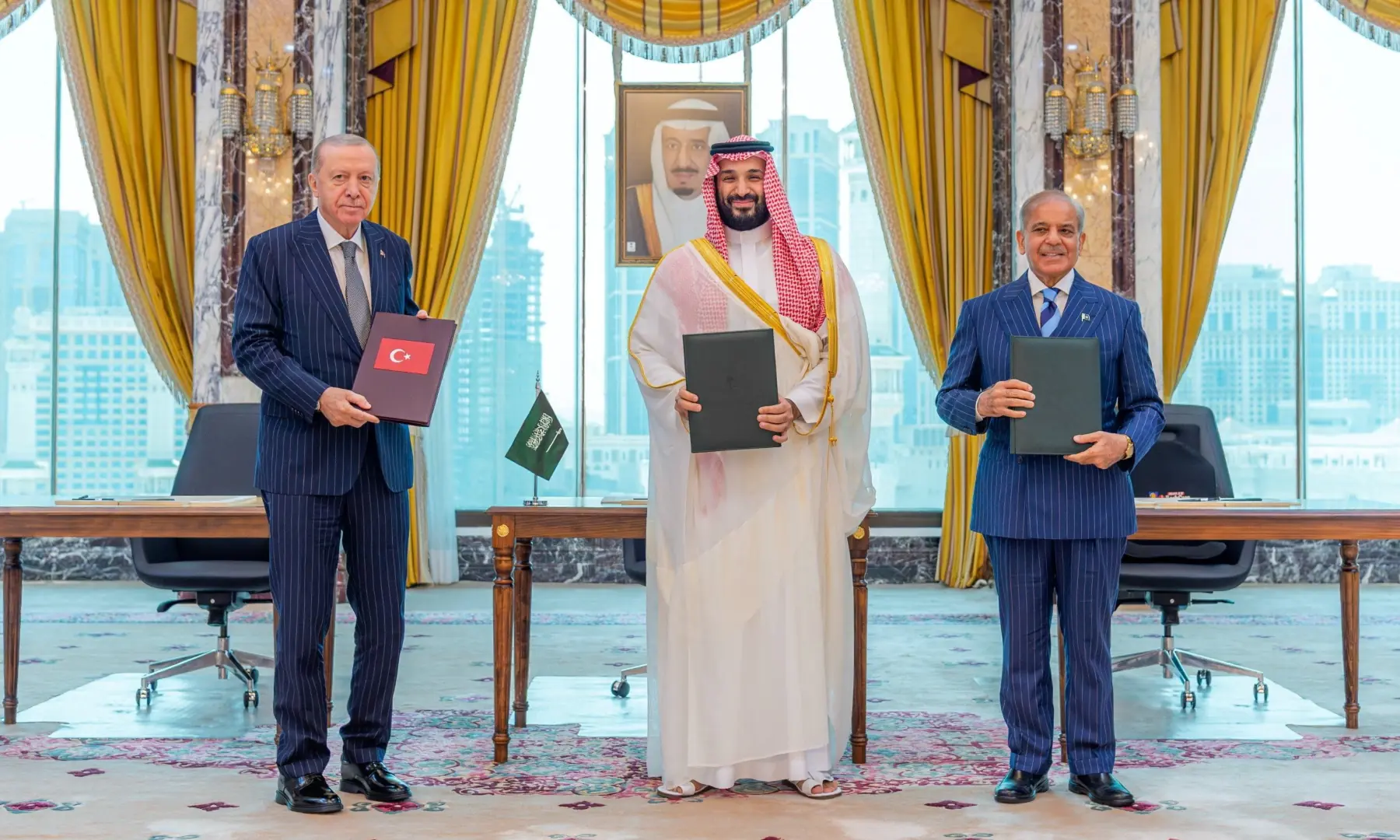
What should Pakistan actually want from the Makkah Joint Defence Agreement?
That is a more useful question than asking whether Saudi Arabia or Türkiye would fight alongside Pakistan in a future conflict with India. Pakistan’s conventional and strategic deterrence must remain nationally anchored. The value of the agreement should therefore be measured by what additional resilience, technology and strategic flexibility it can provide.
From Pakistan’s perspective, three issues deserve particular attention: Iran’s likely response, the economic and defence-industrial benefits Pakistan should seek, and the risks of becoming involved in asymmetric conflict around the Strait of Hormuz and Bab al-Mandab.
Iran may seek influence rather than simple opposition
The obvious assumption is that Iran will regard closer Saudi-Pakistani-Turkish defence cooperation as a threat. That remains possible, particularly if the framework develops an explicitly anti-Iranian character.
But Tehran has another option: engagement.
If the agreement is genuinely presented as contributing to regional stability and does not identify a specific adversary, Iran could argue that it should be included in some form of dialogue or cooperation. From Tehran’s perspective, influencing an emerging regional security framework may be more advantageous than remaining permanently outside it.
This need not mean full membership. Iran could seek structured dialogue, maritime-security cooperation, crisis communication or participation in wider regional mechanisms. Such engagement would allow Tehran to discourage the emergence of an anti-Iranian bloc while supporting its own argument that regional security should increasingly be managed by regional states.
Iran could also pursue engagement while simultaneously testing the framework’s limits through political pressure, proxy activity or other sub-threshold actions. Cooperation and competition are not mutually exclusive.
For Pakistan, keeping space for engagement is important. Islamabad has strong strategic ties with Saudi Arabia, but Iran is also a neighbour whose stability directly affects Pakistan’s western frontier. Pakistan’s interests are therefore better served by a framework that strengthens regional deterrence without forcing a permanent choice between Riyadh and Tehran. This dual possibility—engagement from within and probing from outside—is also identified in the underlying strategic assessment.
Pakistan should focus on what it actually needs
Pakistan should not evaluate the agreement primarily through the India question.
Its defence against India remains fundamentally Pakistan’s own responsibility, and nation has proved its resoleve during May last year both in conventional and strategic domains. Expecting Saudi Arabia or Türkiye automatically to enter a South Asian war would be an unrealistic basis for strategy.
The more relevant question is what Pakistan would need during a prolonged crisis that its partners could realistically provide.
Two requirements stand out.
The first is economic and energy resilience.
A major conflict would place pressure not only on Pakistan’s armed forces but also on fuel supplies, foreign-exchange reserves, imports, government expenditure and critical supply chains. In such circumstances, reliable access to energy and financing could be more strategically important than foreign combat forces.
Saudi Arabia could therefore provide Pakistan with significant strategic depth through pre-arranged fuel supplies, deferred-payment mechanisms, emergency financing and support for critical imports.
These arrangements should ideally be institutionalised before a crisis begins rather than negotiated after economic pressure has already emerged.
A country that can sustain fuel imports and absorb prolonged financial pressure has greater freedom of action. Economic resilience is therefore part of deterrence, not separate from it.
The second major opportunity is defence-industrial cooperation with Türkiye.
Türkiye has developed important capabilities in unmanned systems, electronic warfare, precision weapons, naval technologies and military electronics. Pakistan should seek more than procurement.
The real objective should be technology absorption through joint development, licensed production, local manufacturing, integration of Pakistani systems and long-term sustainment.
A potentially valuable model would combine Turkish technology, Saudi capital and Pakistani engineering, production and operational experience.
Such cooperation would produce benefits even if the collective-defence clause is never invoked. It would strengthen Pakistan’s indigenous capability and reduce long-term dependence on imported finished systems.
This is likely to be one of the most durable strategic gains available under the arrangement.
The main operational risk lies around Hormuz and Bab al-Mandab
The most serious danger for Pakistan is not necessarily a conventional war.
It is involvement in asymmetric conflict around the Strait of Hormuz and Bab al-Mandab.
These environments favour relatively inexpensive methods capable of imposing disproportionate costs: drones, mines, missiles, small boats, sabotage, proxy attacks and disruption of commercial shipping.
A low-cost drone may require an expensive interceptor. A mine can disrupt shipping worth far more than the weapon itself. Even unsuccessful attacks can raise insurance costs, divert naval forces and disrupt trade.
The strategic logic is therefore asymmetric: the cost of defending against the threat may greatly exceed the cost of producing it.
Pakistan must be careful that limited commitments do not gradually expand.
A mission may begin with maritime surveillance or escort duties. But escorts require ships, logistics and sustained deployments. An attack on those forces can create pressure for retaliation, and retaliation can turn maritime security into participation in a wider regional conflict.
Clear limits are therefore essential.
Pakistan should distinguish between protecting its own shipping, contributing to regional maritime security and participating in offensive operations against actors threatening navigation. These are different levels of commitment and should not be treated as interchangeable.
Hormuz creates an additional problem because a conflict there could require greater Pakistani military involvement precisely when Pakistan itself is suffering from higher energy prices and disrupted supplies. The same crisis could therefore increase Pakistan’s military costs while weakening its economic capacity to bear them.
This reinforces the importance of securing energy and financial arrangements before accepting broader military obligations.
Collective defence does not require identical responses
The agreement can remain useful without requiring all three states to react identically to every crisis.
Saudi Arabia may contribute financing and logistics.
Pakistan may contribute air defence, personnel or operational expertise.
Türkiye may contribute technology, intelligence and specialised military capabilities.
Differentiated contributions are not necessarily a weakness. They may be what makes the framework sustainable.
The real requirement is clarity.
The members need a shared understanding of what different levels of crisis could require: consultation, intelligence sharing, economic assistance, logistics, munitions, air defence, maritime support, forward deployment or direct combat.
An agreement with modest but clearly understood obligations may ultimately be more credible than one with expansive language whose practical meaning remains uncertain.
The standard Pakistan should use
Pakistan should approach the arrangement through clearly defined national requirements.
It should seek: reliable energy and financial support in crisis; Turkish technology transfer and joint defence production; stronger intelligence and early-warning cooperation; improved maritime-domain awareness; greater regional diplomatic influence; continued room for engagement with Iran;
and clear limits on military commitments where Pakistan’s direct interests are limited.
If the agreement delivers these outcomes, it can significantly strengthen Pakistan even without Saudi or Turkish military intervention against India.
If, however, it evolves into open-ended commitments in Gulf and Red Sea conflicts while providing limited economic or technological return, the balance becomes much less favourable.
The central test is therefore simple:
Does the agreement expand Pakistan’s strategic options, or reduce them?
Its success should be measured not by the symbolism of collective-defence language, but by whether Pakistan can convert the relationship into economic resilience, energy security, technological capability and greater regional influence while preserving the freedom to decide when Pakistani military power should be used.
That is the strategic value Pakistan should seek from the Makkah Joint Defence Agreement.