ISLAMABAD: The National Electric Power Regulatory Authority (NEPRA) on Tuesday came under intense fire for allowing what were termed blatantly “unjustified” costs to power sector entities such as the Central Power Purchasing Agency–Guaranteed (CPPA-G) without conducting any serious scrutiny of their past performance—effectively transferring the cost of inefficiency onto already distressed electricity consumers.
The criticism erupted during a public hearing on a petition filed by CPPA-G seeking determination of its Market Operator Fee (MOF) for FY 2025–26.
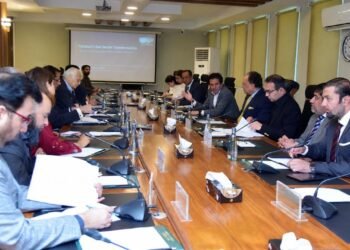
The hearing was presided over by NEPRA Chairman Waseeem Mukhtar, along with Member (Law) Amina Ahmed and Member (Development), as the Authority currently operates with only three members. Absence of former Member (Technical), Rafique Ahmad Shaikh was felt during the hearing. A CPPA-G team, led by CEO Rihan Akhtar, attempted to justify the steep cost escalation and defend the submissions before the regulator.
Consumer representatives Rehan Jawed, Aamir Sheikh, and Arif Bilwani mounted a strong challenge to CPPA-G’s figures, assumptions, and overall claims, arguing that chronic mismanagement in the power sector has not only crippled industrial activity but has also pushed the national economy toward collapse.
In its petition, CPPA-G has sought a staggering 61.5 percent increase in its net revenue requirement for FY 2025–26, raising it to Rs 4.664 billion from Rs 2.887 billion. If approved, the MOF would rise to Paisa 3.80 per kWh from Paisa 2.35 per kWh, based on projected energy of 122,723 GWh and an average MDI of 26,500 at Rs 14.67 per kW per month.
The proposed cost structure includes Rs 2.225 billion under general costs, comprising administrative expenses of Rs 322 million, office operations, services and maintenance of Rs 241 million, and CAPEX of Rs 164 million—pushing the gross revenue requirement to Rs 2.953 billion.
Additional claims include recoverable loan advances to employees amounting to Rs 409 million, new hiring costs of Rs 298 million, and estimated taxes of Rs 300 million.
CPPA-G has further sought Rs 960 million as Prior Year Adjustment (PYA), including Rs 474 million for MLR covered under PYA and Rs 343 million under other heads. Even after adjusting for Rs 900 million in other income and Rs 173 million recovered from employee loans, the agency is still seeking NEPRA’s approval for a net revenue requirement of Rs 4.664 billion.
NEPRA’s Director Tariff, Mubashir Bhatti, questioned the sharp increase in employee salaries, particularly in light of last year’s financial impact when several CPPA-G employees left the organisation to join the Power Planning and Monitoring Company (PPMC).
CPPA-G’s mandate is to procure electricity from power producers and sell it to distribution companies. Meanwhile, outstanding dues of Independent Power Producers (IPPs) have ballooned to Rs 1.2 trillion, including Rs 500 billion owed to Chinese power plants established under CPEC—highlighting the sector’s deepening financial crisis.
Despite this alarming backdrop, CPPA-G has proposed nearly a 60 percent increase in board members’ fees, taking the total to Rs 40 million for FY 2025–26, with a per-meeting fee of Rs 60,000.
Questioning the justification, Member (Law) asked how many board meetings were held in the previous year. The CPPA-G CEO disclosed that 40 meetings of the board and its committees had been conducted.
Consumer representatives strongly criticised what they described as NEPRA’s continued leniency toward power sector entities, accusing the regulator of approving rising costs without performance evaluation and ignoring blatant overlaps among CPPA-G, PPMC, and ISMO.
“NEPRA must rigorously scrutinise the past performance of CPPA-G and similar entities before approving further costs—especially when their role is expected to diminish following the government’s decision to exit electricity trading,” said Rehan Jawed. “These entities have become a permanent burden on consumers, while industries are shutting down under the weight of exorbitant power tariffs.”
The representatives further argued that at a time of historic underperformance in Pakistan’s power sector, NEPRA’s regulatory approvals and unchecked cost escalations by CPPA-G, PPMC, and ISMO have effectively entrenched inefficiency, ensuring that every failure is monetised and passed directly on to consumers.
Responding to the criticism, CPPA-G CEO Rihan Akhtar acknowledged that the agency would be wound up after the power purchase agreements of 104 IPPs expire over the next 14–15 years. However, he said the entity currently manages IPP transactions worth approximately Rs 4 trillion annually.
Arif Bilwani strongly objected to the inclusion of 10,000 MW of new projects under the banner of so-called strategic initiatives. “Have mercy on the country, consumers, and industry,” he said. “The failures of the power sector have dragged the entire economy into distress.”
Bilwani also questioned whether NEPRA honours the dissenting notes of its former Member (Technical), Rafique Ahmad Shaikh. The Authority offered no response to the query.
Another industrial consumer, Aamir Sheikh, urged NEPRA to conduct revenue determinations for CPPA-G, ISMO, and PPMC simultaneously to expose the full scale of duplication and inefficiency.
He said the public is alarmed that a 250-employee organisation seeks Rs 400 million in new loans every year while also demanding provisions of Rs 250 million for bonuses. “Industries that cannot even pay salaries on time due to crushing electricity prices are being forced to finance loans and bonuses for CPPA-G employees, on top of already lucrative salary packages,” he said.
The case officer of NEPRA also questioned the justification for additional funding for multiple IT projects. A CPPA-G official responded that the organisation is expanding its IT setup to handle various tasks, including cybersecurity, claiming thousands of cyberattacks are being repelled annually.
CEO Rihan Akhtar asserted that CPPA-G’s workforce is rendering critical services to the nation and consumers, adding that the government is considering a joint IT setup for the entire power sector.
Reacting to the request for additional IT funding, Member (Development) Maqsood Anwar Khan remarked that the proposal made it appear as though CPPA-G was planning to establish an IT park rather than rein in costs.
CPPA-G has requested the Authority to permit offsetting negative expenditure adjustments in one head against excess expenditures in another head, rather than capping expenditures individually and allowing only downward adjustments after considering the Company’s overall expenditure as reflected in the audited financial statements. This approach would more accurately reflect the operational realities and resource reallocations necessary.
The Authority has been requested to allow the actualization of expenditure based on the audited financial statements of FY 25-26 when available.
The Authority may also allow immediate application of the above-mentioned CPPA-G Fee and related PYA and other submission under Sub-Rule 7 of Rule 4 of the NEPRA (Tariff Standards and Procedures) Rules, 1998.
During the hearing, increase in salary of Managing Director PPMC, with quoting his name. Member (Law ) NEPRA was also surprised on massive jump in the salary.
Ends