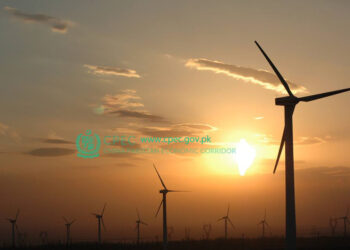
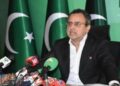
ISLAMABAD : Minister for Power, Sardar Awais Ahmad Khan Leghari said on Saturday that Pakistan is to increase its clean energy share to over 90% by 2035 as currently it is generating g 52% of its electricity from clean and renewable sources, including hydro, solar, wind, and other technologies.
Addressing an international conference, Minister stated that Pakistan contributes less than 1% of global greenhouse gas emissions. Yet, as UNEP’s Climate Risk Index indicates, it is one of the top 10 climate-vulnerable countries.
The nation faces annual climate-induced losses exceeding €4 billion, impacting agriculture, infrastructure, water systems, and communities. For Pakistan, the energy transition is not merely an environmental responsibility it is a matter of national security, economic survival, and human development.
In response to these challenges, Pakistan is pursuing a comprehensive clean energy strategy anchored in the principles of decarbonization, digitization, and decentralization. In recent years, Pakistan has also undergone one of the world’s most remarkable people-driven solar revolution, a transformation now increasingly acknowledged by international research institutions and development partners.
” This revolution has allowed 50GW worth of solar panels being imported to Pakistan. Despite economic challenges, Pakistani households, farmers, small businesses, and industries have adopted rooftop and distributed solar at an unprecedented pace, making Pakistan one of the fastest-growing residential solar markets in Asia according to multiple independent assessments, including insights referenced by the World Bank and regional energy think tanks. This has demonstrated to the world that when people are empowered with the right policy environment, clean energy adoption can scale faster than anyone anticipates, ” he added. Currently, 17000 MW of electricity is being generated from solar ( net metering and off-grid) .
The government is accelerating the uptake of renewable energy by expanding clean energy projects and advancing the integration of battery energy storage systems in areas like Gilgit Baltistan and Gwadar.
The Minister further stated that efforts to digitize the power system are well underway. Pakistan is deploying advanced metering infrastructure, and modernizing ICT frameworks to improve reliability, reduce losses, and enhance transparency. This shift toward digital energy governance is essential for enabling a modern smart grid capable of accommodating higher shares of renewables.
Other major reforms of Power Sector include ;(i) privatization of DISCOs to improve efficiency, reduce losses, and enable performance-based management ;(ii) sale of redundant power plants to rationalize generation capacity and reduce financial burden ;(iii) reduction in industrial tariff to enhance competitiveness, support exports, and stimulate economic growth ;(iv) launch of the Surplus Power Package to fully utilize available generation capacity and improve DISCO revenues ;(iv) appointment of competent and independent DISCO boards, ensuring professional oversight and governance ;(v) reforms in net metering, making the system more sustainable while protecting consumer interests and grid stability ;(vi) significant reduction in circular debt, supported by efficiency improvements and governance interventions ;(vii) digitization of distribution networks through large-scale deployment of smart meters and SCADA systems ;(viii) launch of a consumer self-reading Meter App by the name Apna meter apni reading , enhancing billing transparency and customer empowerment ;(ix) establishment of the 118 Helpline, a standardized and responsive national platform for complaint resolution ;(x) Creation of a technical arm—PPMC, providing specialized support to DISCOs for planning and performance improvement ;(xi) restructuring of NTDC into NGC and EIDMC, strengthening grid operations, project execution, and institutional accountability ;(xii) solarization of agricultural tube wells in Balochistan, reducing dependence on diesel and addressing water-energy challenges ;(xiii) electrification of strategic regions such as Gwadar and Gilgit through targeted solarization programs to improve energy access and security ;(xiv) implementation of a vigilant review mechanism on regulatory decisions to ensure transparency and sectoral stability ;(xv) operationalization of the competitive wholesale energy market (CTBCM) to promote transparency, competition, and investor confidence ;(xvi) reduction in EV charging tariffs to encourage electric mobility and support the national decarbonization agenda ; and (xvii) implementation of the Energy Conservation Building Code (ECBC) in building authorities to optimize energy efficiency in the construction sector.