
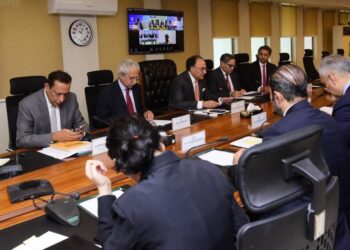
ISLAMABAD: Federal Minister for Finance and Revenue Senator Muhammad Aurangzeb held a meeting at the Finance Division with the new leadership of the Securities and Exchange Commission of Pakistan (SECP), led by Chairman Kabir Ahmed Sidhu and Commissioner Ali Farid Khawaja, who called on the Finance Minister today.
The Finance Minister’s core team at the Finance Division, including senior officers overseeing debt management, capital market development, and regulatory coordination, was also in attendance.
Welcoming the new SECP leadership, the Finance Minister expressed confidence that their extensive domestic and international market experience would strengthen Pakistan’s regulatory framework and accelerate the development of capital markets. The meeting focused on aligning priorities to deepen capital markets, diversify financing sources for the public and private sectors, and improve investor confidence through efficient regulation, modern infrastructure, and coordinated policy action.
The Finance Minister highlighted the Government’s move toward a more integrated reform approach through the Capital Markets Development Council, with finalized terms of reference aimed at shifting from institution-specific silos to a horizontal, system-wide market development agenda. The objective, he noted, is to leverage progress already achieved across various market institutions while addressing gaps that require regulatory reform, legislative support, and inter-agency coordination.
A major focus of the discussion was the development of Pakistan’s debt capital markets. The Finance Minister emphasized the need to reduce reliance on banks as the primary source of financing and to broaden participation by insurance companies, asset managers, pension funds, and retail investors, in line with sound asset-liability management practices. The Finance Division shared ongoing work to strengthen domestic debt management through improved front, middle, and back office functions and liability management operations, noting that the next phase requires close collaboration with SECP to expand market depth and efficiency.
Participants identified the reduction of friction and intermediation costs as a key priority. It was noted that multiple layers in the issuance-to-investor chain add cost and delay, limiting the effectiveness of debt capital markets. The meeting agreed that streamlining market architecture, improving issuance processes, and enhancing secondary market functioning are essential to better connect borrowers with investors and support sustainable market growth.
Investor onboarding and market access were discussed as critical enablers of liquidity and participation. The meeting reviewed the need for faster, genuinely digital account opening processes, risk-based KYC, and consent-based portability of KYC across financial institutions. Improving ease of entry for retail investors was identified as a priority, particularly to channel participation from informal or unregulated investment avenues into the formal capital market.
The SECP leadership shared initial observations on regulatory frameworks for NBFCs, SME-focused finance, and insurance, noting the need to revisit and strengthen these frameworks to support access to finance while maintaining prudential oversight. The discussion emphasized a regulatory approach that enables business activity, reduces unnecessary procedural delays, and promotes compliance through digital tools.
On the equity market side, the meeting welcomed signs of improving IPO activity and discussed measures to broaden participation in equity capital market transactions. The Finance Minister underscored the importance of expanding the pool of institutions able to support capital raising activity, enhancing competition, and ensuring that market infrastructure has adequate capacity to process increased issuance without bottlenecks.
Alternative investment vehicles were identified as an important channel for mobilizing private capital, particularly for infrastructure and other priority sectors. The meeting reviewed the need to ensure that regulated fund structures translate into real investment activity rather than remaining passive or tax-driven vehicles. Policy and tax-related challenges affecting private equity and venture capital were also discussed, including the need to address structural issues that discourage fund formation and long-term investment.
The role of public capital markets in the Government’s privatization agenda was also considered. The meeting noted that listings and market-based price discovery can complement strategic transactions by widening investor participation, improving valuation transparency, and strengthening corporate governance, where appropriate. Emerging areas such as digital assets and tokenization were discussed in an exploratory context.
The Finance Division briefed participants on early-stage work examining the tokenization of government debt as a potential use case to expand investor reach and improve settlement efficiency. The discussion stressed the importance of managing expectations, recognizing that tokenization is not a substitute for underlying investor demand, and that robust regulation, investor education, and institutional capacity are prerequisites for success.
Towards the end, the Finance Minister reaffirmed the Government’s commitment to close coordination with SECP on a time-bound reform agenda focused on market deepening, investor expansion, reduced transaction costs, faster approvals, and transparent, competitive regulation. The SECP leadership expressed its commitment to working with the Finance Division and market stakeholders to translate these priorities into actionable reforms with measurable outcomes.
FM chairs meeting of CMDC
ISLAMABAD: Federal Minister for Finance and Revenue, Senator Muhammad Aurangzeb, chaired a meeting of the Capital Market Development Council (CMDC)...
Read more