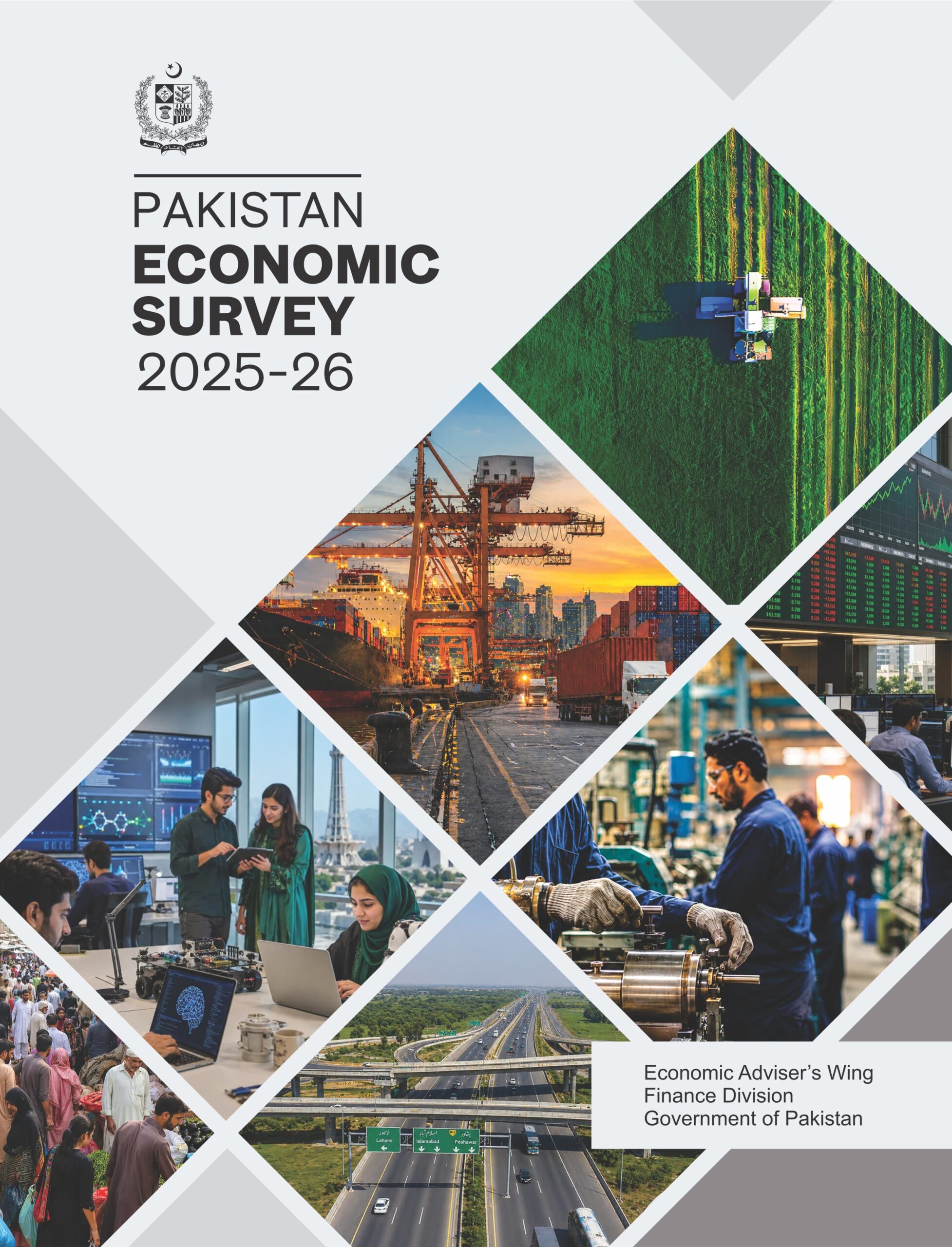
ISLAMABAD: Pakistan’s economy demonstrated resilience during FY2025-26, achieving a growth rate of 3.7 percent despite significant domestic and global challenges, as the government consolidated macroeconomic stability and advanced structural reforms, according to the Economic Survey 2025-26.
Launching the Survey, Finance Minister Muhammad Aurangzeb said the economy has transitioned from stabilization toward sustainable growth, with the current year’s growth rate marking the highest in the last four years, compared to 3.18 percent in the previous fiscal year.
He said the size of the economy reached a record Rs 126.9 trillion ($452.1 billion), while per capita income rose to $1,901 from $1,751 last year.
The Survey noted that Pakistan entered FY2026 with restored macroeconomic stability and continued to strengthen recovery despite pressures from the 2025 monsoon floods, which strained infrastructure, agriculture, and public services. The government, through coordinated federal and provincial efforts, managed relief and recovery operations while maintaining fiscal discipline and protecting vulnerable populations.
Global economic conditions also remained challenging, with volatile energy prices, supply chain disruptions, tight financial conditions, and regional geopolitical tensions—particularly the Middle East conflict—impacting fuel costs, freight rates, insurance premiums, and remittance flows.
Despite these headwinds, the economy maintained stability. Inflation declined significantly from crisis levels, large-scale manufacturing rebounded, and the external sector improved.
The current account posted a surplus of $72 million during July–March FY2026, supported by strong remittance inflows and improved financial account performance. Foreign exchange reserves rose to multi-year highs, while investor confidence strengthened, reflected in improved performance of equity and sovereign debt markets.
The Finance Minister highlighted that Pakistan also achieved one of its strongest fiscal performances in recent years, maintaining fiscal consolidation and recording a historic primary surplus. Public debt indicators improved, and debt maturities were extended. The country also re-entered international capital markets and launched its Panda Bond initiative at competitive rates.
Sector-wise, agriculture grew by 2.89 percent despite flood-related disruptions, while industry expanded by 3.51 percent. Large-scale manufacturing recorded a robust growth of 6.1 percent, with 16 out of 22 sectors posting positive performance.
The services sector remained a key driver, growing by 4.9 percent—the highest in four years—led by strong performance in Information and Communication Services, which grew by 7.52 percent.
On the fiscal side, the deficit remained contained at 0.7 percent of GDP during the first nine months, supported by a 10.1 percent increase in FBR revenue collection and a 23 percent reduction in markup payments, creating additional fiscal space.
On the external front, the Finance Minister noted that IT exports surpassed $3.8 billion and are projected to reach $4.5 billion. Workers’ remittances remained strong, supported by inflows through Roshan Digital Accounts.
Foreign exchange reserves stood at $17.1 billion and are expected to reach $18 billion by the end of June.
The Survey further highlighted rising domestic demand, with cement consumption increasing by 10 percent, fertilizers by 17 percent, petroleum products by 5 percent, and mobile phone demand by 9 percent.
The government continued to implement a broad structural reform agenda under the IMF-supported programme, focusing on tax reforms, digitization, tariff rationalization, energy sector restructuring, pension reforms, public debt management, and privatization of state-owned enterprises.
Key reforms included operationalization of a competitive multi-buyer electricity market, expansion of digital invoicing and enforcement systems, and progress on rightsizing government institutions.
The Survey also emphasized progress in digital and financial inclusion, with expansion of digital payments, fintech innovation, and financial access initiatives supporting formalization of the economy and improved public service delivery.
At the same time, Pakistan is positioning itself to benefit from emerging global trends in digital assets, blockchain, and financial innovation.
The government maintained focus on social protection, safeguarding vulnerable groups from the impact of economic adjustments while continuing investment in human capital, infrastructure, and climate resilience.
The Survey concludes that Pakistan’s experience in FY2026 demonstrates that economic stabilization can be effectively combined with a renewed growth trajectory, provided policy consistency, institutional coordination, and reform momentum are sustained. Ends
PC appoints ADB FA to outsource operations of Islamabad Airport
ISLAMABAD: Privatisation Commission (PC) has appointed Asian Development Bank (ADB) as Financial Adviser for the Outsourcing of Operations of Islamabad...
Read more