Maryam Asim
Date: March 15, 2026
Dubai built its global image on luxury, safety, and spectacle. But war destroys more than buildings. It destroys security. Once security is shaken, confidence collapses with it. For a city built on confidence, that is a deeper wound than physical damage alone.
The city now faces more than physical damage. Lives have been lost. People have been wounded. Key sites, including the airport and the US Consulate, have reportedly been hit. Hotels have also come under attack. For a place that sells itself as a haven of comfort and stability, that is a devastating blow.
Dubai is not a city in the ordinary sense. It is a city-sized resort sustained by outsiders. The overwhelming majority of its residents are foreigners. More than 92% of its nearly 4 million people are expatriates. Some are wealthy expatriates drawn by tax advantages and luxury. Others are the workers who keep the city running, many of them from South Asia, often in low-paid and insecure roles. Dubai depends on both. It depends on the rich to spend and on the poor to serve.
That is why this crisis cuts so deeply. A city built on tourism, investment, retail, connectivity and image cannot afford to look unsafe. Who wants to holiday in a war zone? Who wants to put money into a place where missiles are falling, hotels are being struck, and even the airport is no longer beyond reach?
This is why the authorities appear so desperate to control the narrative. Public comments that challenge official announcements are treated not as concern, but as threat. Residents are warned not to say anything that could cause alarm. The message is unmistakable: the image of calm must be preserved, even when calm itself is breaking down.
That approach may protect headlines for a moment, but it does not restore trust. When officials describe visible damage as harmless debris, or recast attacks as proof of successful defense, the public is asked to doubt its own eyes. Yet people can see what is happening. They can hear it. They can watch the panic spread. They can watch others head for the airport, even as the airport itself no longer feels secure.
The deeper problem is that Dubai’s prosperity has always rested on perception. Unlike some of its regional neighbors, it cannot simply fall back on vast oil wealth. Its economy runs on tourism, consumer spending, real estate, logistics, and finance. In the first nine months of 2025, Dubai generated $96.7 billion in GDP and recorded 4.7% growth. Real estate transactions reached a record $249.7 billion, while exports and re-exports hit $97.1 billion. It is a place designed to attract money, movement, and desire. But those things are fragile. They disappear quickly when fear enters the picture.
And fear is now striking at the most sensitive part of Dubai’s model: Connectivity. The city was built on arrivals and mobility. New workers, new tourists, new investors, new residents. But once security falters, movement reverses. The same openness that made Dubai flourish can quickly become a weakness when people begin to leave.
This is what makes Dubai unusually exposed. In many countries, war traps a population in place. In Dubai, a huge share of the population can go. That changes everything. A city whose success depends on temporary confidence is always more fragile than its skyline suggests.
People are not only worrying about Dubai. They are beginning to flee it. Families are reconsidering whether to stay. Businesses are reassessing risk. Workers are asking whether the rewards still justify the danger. In a place where so many residents are there by calculation rather than citizenship, the collapse of security changes the calculation itself.
That is why this is more than a security shock. It is a confidence shock. Dubai does not depend only on infrastructure, trade, and luxury spending. It depends on millions of people continuing to believe it is worth staying. The moment that belief weakens, the damage is no longer temporary. It becomes structural.
The war has also exposed the contradiction at the heart of Dubai’s position. It presents itself as a playground of luxury and commerce, yet it is also tied to a wider regional security order shaped by military power. Strategic facilities connected to the United States and its allies are part of that reality. Once a city becomes linked to conflict in that way, it cannot assume the violence will remain somewhere else.
Dubai wanted the benefits of global alignment without the costs. It wanted to be both untouchable and strategically important. That illusion is now collapsing.
The social realities beneath the glamour are becoming harder to ignore. The city’s wealth has long depended on a vast labor force drawn from poorer countries, especially across South Asia. These workers build, clean, drive, deliver, and maintain the dream Dubai sells to the world. Yet in moments of crisis, it becomes painfully clear how unequal that model is. Some experience Dubai as privilege. Others experience it as dependence. All are now exposed to instability.
Particularly affected is Dubai’s large Pakistani community, one of the city’s most significant expatriate groups. Pakistani nationals have invested heavily in Dubai real estate, owning roughly 22,000 properties worth more than $12.5 billion. Those hard-earned investments now face falling values, weaker liquidity, and deep uncertainty. The wider cost could be just as serious. The UAE sent nearly $8 billion in remittances to Pakistan in the last fiscal year, and that lifeline will weaken if workers return home or lose their jobs.
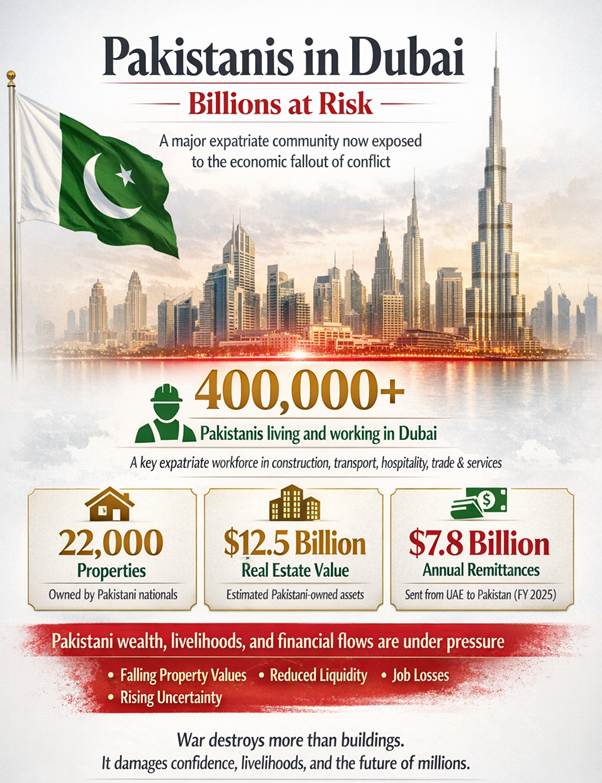
Figure 1: Pakistanis in Dubai face rising economic risk as conflict threatens property holdings, livelihoods, and remittance flows.
Yet the toll is already visible far beyond the streets. The DFM Real Estate Index has suffered one of its sharpest collapses in years, exposing how quickly confidence can drain from a city built so heavily on perception. As retaliatory strikes hit airports, consulates, and even luxury hotels, the illusion of Dubai as an untouchable haven has cracked wide open, sending listed real estate counters into freefall. Pakistani investors are especially exposed. Their hard earned billions in property now face not only weaker values and thinner liquidity, but a deeper crisis of trust sweeping social media and trading floors alike. Once that belief breaks, the damage stops being temporary. It begins to look structural.
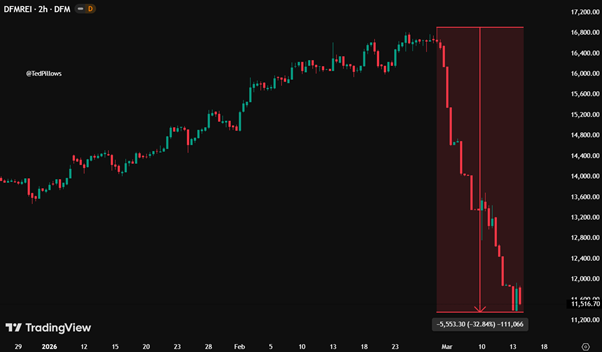
Figure 2: The DFM Real Estate Index plunged as war shattered confidence in Dubai’s property market.
There is another uncomfortable truth beneath the surface. The people with the least power often have the fewest options. Wealthy residents can leave faster. Investors can redirect money. Tourists can cancel trips. But low-paid migrant workers are often bound by employers, contracts, and circumstances beyond their control. The city’s unequal structure becomes even starker when danger arrives.
There is also a larger lesson here. War does not stay confined to military maps or official briefings. It spills into daily life. It reaches airports, shopping districts, beaches, boardrooms, and hotel lobbies. It alters investor calculations. It shakes tourist confidence. It makes even ordinary routines feel uncertain.
That is what makes this moment so dangerous for Dubai. The city is not only under pressure from missiles. It is under pressure from reality. A place built on branding, control, and the promise of insulation is being forced to confront the fact that no amount of wealth can fully seal off geopolitics.
What is now breaking down is not only physical safety, but the core promise on which Dubai sold itself to the world. It offered wealth without taxation, luxury without instability, and opportunity without the political burdens that trouble other parts of the region. That promise was always central to its appeal. Once shaken, it cannot be repaired with messaging alone.
A damaged building can be rebuilt. A runway can reopen. A hotel can resume business. But security is different. Security is the invisible guarantee behind every visible success. It is what makes investment possible, tourism attractive, and daily life bearable. Once people stop trusting in it, every other strength begins to lose value.
Censorship may delay panic. It may soften the headlines. It may buy time. But it cannot rebuild credibility once people feel that the truth is being managed instead of told.
Dubai’s greatest vulnerability is not only military exposure. It is its dependence on the belief that it stands above the chaos of the region around it. Once that belief breaks, the damage reaches far beyond any single strike.
In the end, Dubai has lost the one thing that made everything else possible: security. It is not a loss that can be measured in money, because security was the foundation on which the city’s wealth, confidence, and appeal were built. Once that foundation breaks, everything above it begins to fail.
This is no longer just a security crisis. It is a crisis of image, legitimacy, and survival. For a city built on the promise of connectivity and safety, there is no deeper loss than the loss of security itself. And once that promise dies, everything Dubai built upon it begins to die with it.
Maryam Asim is a Economics student at the National University of Sciences and Technology (NUST), Pakistan. Her academic focus includes global economic trends, development challenges, and the intersection of economics and geopolitics.